Tomato Seed Classification with Artificial Intelligence: A SqueezeNet-Based Approach
DOI:
https://doi.org/10.58190/icisna.2025.150Keywords:
artificial intelligence, classification, deep learning, SqueezeNet, seed separation, seed quality, tomato seedsAbstract
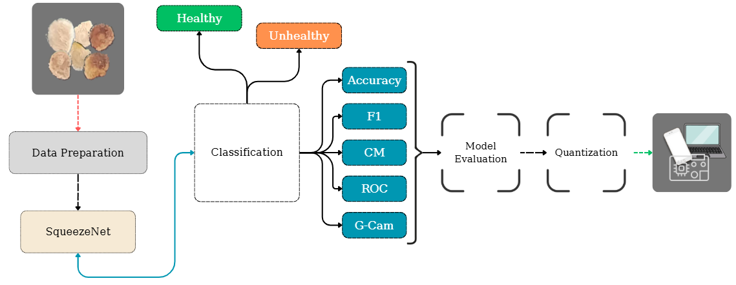
The development of agricultural technologies is of great importance in improving agricultural production processes, enhancing crop quality, reducing production costs, and optimizing resource utilization. Seed quality is crucial in agricultural production in terms of plant development and yield. The use of high-quality seeds supports healthy plant development, thus increasing the productivity and sustainability of agriculture. Traditional methods rely on approaches such as visual inspection, manual sorting, and biological testing. However, these methods have significant limitations due to their time-consuming nature, dependence on human experience, and inability to provide sufficient efficiency in large-scale applications. In this study, an artificial intelligence-based decision mechanism is proposed for the automatic classification of healthy and unhealthy tomato (Solanum lycopersicum) seeds. A dataset of tomato seeds was specifically created for this study. The dataset consists of a total of 200 tomato seed images obtained under different environmental conditions, and the generalization ability of the model was strengthened by applying data augmentation and various preprocessing techniques. A deep learning-based SqueezeNet model, capable of providing high accuracy rates with low memory requirements, was used for feature extraction from the obtained tomato seed images. Model performance was evaluated using a 5-fold cross-validation method, and classification accuracy, precision, sensitivity, and F1 score were analyzed. Furthermore, quantization was applied to assess the model's usability in mobile and field applications, and it was observed that discrimination was achieved without performance loss. In comparative analyses, experiments with a YOLO-based object detection approach revealed that lightweight CNN architectures that perform direct classification are more effective when dealing with small and visually similar objects. In conclusion, this study demonstrates that a SqueezeNet-based deep learning approach offers high accuracy, low computational cost, and practical applicability in the automatic classification of tomato seeds. The proposed method has the potential to reduce human error in agricultural quality control processes and contribute to the rapid and reliable assessment of seed quality.