Deep Learning Methods for The Classification of Turkish Music Genres
DOI:
https://doi.org/10.58190/icisna.2025.136Keywords:
Music Genre Classification, Natural Language Processing, Deep Learning, Ensemble Learning, TurkBERT, Llama-3, Text MiningAbstract
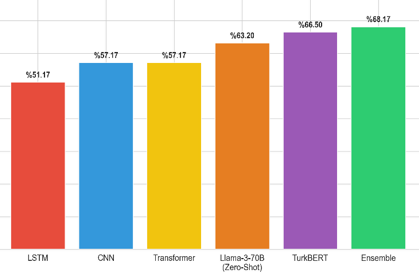
Accurate classification of music genres is essential for the effective management of digital music archives and for improving the reliability of recommendation systems. Traditional approaches based on audio signal analysis often fail to utilize the rich semantic and structural information embedded in song lyrics. In this study, a deep learning–based method is proposed for the automatic identification of music genres by using Turkish song lyrics. An original dataset consisting of four thousand songs collected from real-world sources and balanced to eliminate class imbalance was constructed. Comprehensive normalization procedures compatible with Turkish morphology were applied during the text preprocessing stage. The classification performance was evaluated using Convolutional Neural Networks, Long Short-Term Memory networks, Transformer-based architectures, and a pretrained Turkish Contextual Language Representation model. Additionally, to assess the performance of these models relative to large-scale language models, the Llama-3-70B model was tested using a direct inference approach without any additional training. Furthermore, a weighted ensemble learning architecture that integrates the predictions of different models was developed. Experimental results show that among the individual models, the Turkish Contextual Language Representation model achieved the highest accuracy. However, the proposed ensemble learning architecture outperformed all single deep learning models and the Llama-3-70B model, achieving 68.17 percent accuracy, 0.68 F1-score, 0.69 precision, and 0.67 recall. Genre-specific results indicate that the Rap genre exhibited the highest discriminability with an F1-score of 0.92, whereas Pop (0.61 F1), Rock (0.58 F1), and Arabesque (0.57 F1) displayed notable overlaps in lyrical and thematic characteristics.